
Rarest of the Rare
Top 10 Cricket Artefacts You Will Never See Elsewhere
If you are searching for Pune's best museum, a rare cricket spot in India, or simply a good weekend place to visit in Pune, Blades of Glory should be at the top of your list. We hold the rarest cricket collection in the world, with over 75,000 pieces of memorabilia spanning more than a century of the sport. This section, Rarest of the Rare, goes a step further. Every piece here is match used, player worn, or tied to a moment that changed the game, the kind of rare cricket artefact you will not find on display anywhere else in India. From a blade of grass off the Lord's outfield to the bat that carried Virat Kohli through his greatest IPL season, here are ten artefacts, and ten stories, that make Blades of Glory one of the rarest cricket spots in the world.

Sachin Tendulkar’s 2011 World Cup Jersey
On the night of 2 April 2011, Sachin Tendulkar walked out at Wankhede Stadium for what many believed was his last real shot at the one trophy that had eluded him across six World Cups. India chased down Sri Lanka's total with MS Dhoni finishing the match with a six into the stands, and a 28 year wait for the World Cup ended in Tendulkar's home city, in front of a crowd that had willed him there for two decades.
The jersey Tendulkar wore that final is the centerpiece of our World Cup zone, and remains one of the best World Cup artefacts on public display anywhere. Our World Cup collection has since grown to cover multiple eras of the tournament, from 1975 through to more recent editions, so visitors get a full timeline of World Cup history in one place. Among all of it, the 2011 jersey stands out, both for its condition and for what that night meant to Indian cricket.
See it for yourself: Plan your visit to the Sachin Tendulkar zone at Blades of Glory Cricket Museum, Pune.


Virat Kohli’s 2016 Bat
2016 is the year most cricket fans point to when asked about Virat Kohli's best batting season. Playing for Royal Challengers Bangalore, Kohli scored 973 runs in a single IPL season, a record that still stands, with four centuries along the way, including twin hundreds in the space of a few days against Gujarat Lions and Sunrisers Hyderabad. RCB fell agonisingly short in the final that year, but Kohli's individual season is still spoken about as one of the greatest in T20 history.
The bat on display in our Virat Kohli zone is the one he used through that entire run, not a promotional bat or a replica. If you have ever searched for the Virat Kohli 2016 bat or wanted to see the willow behind his best IPL innings, this is the real one.
See it for yourself: Head to the Virat Kohli zone to see the bat behind IPL 2016's 973 run season.

Test Match Pink Ball
On 27 November 2015, at the Adelaide Oval, Australia and New Zealand walked out for the first ever day-night Test match, played with a pink ball under floodlights instead of the traditional red one. The pink ball behaved differently in the evening haze and under dew, batsmen struggled in the twilight session, and the format sparked a debate in cricket that continues to this day. Australia won a tight contest, and Test cricket had a genuinely new chapter.
Blades of Glory holds an authentic, match-used pink ball connected to that period of the format's history, one of the more unusual and historically significant artefacts in our collection, and a good stop for anyone curious about the technical side of the game rather than just player memorabilia.
See it for yourself: Explore the ball that started day-night Test cricket as we know it.

Muttiah Muralitharan 520th Wicket Jersey
Across two decades of international cricket, Muttiah Muralitharan turned his unusual bowling action and doosra into 800 Test wickets, more than any bowler in the game's history. His 520th Test wicket was one of many milestones on that road, a marker of a career built on relentless variation, patience, and control that few spinners have matched before or since.
The jersey he wore that day is on display at Blades of Glory, alongside context on his journey and his impact on Sri Lankan cricket. For fans of spin bowling, it is one of the rarest cricketing artefacts you can see in person anywhere in the world.
See it for yourself: Stand before the jersey that witnessed one of spin bowling's greatest milestones.
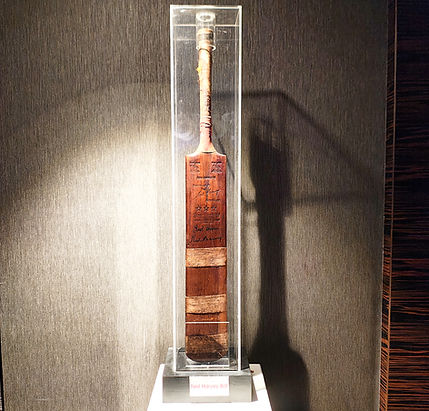
Neil Harvey's Bat (1940s)
Neil Harvey remains one of Australia's most electrifying batsmen, a left-hander who scored over 20,000 first-class runs across a career that ran from 1946 to 1963. He became the youngest Australian to score a Test century, made six centuries in his first thirteen Test innings, and struck a career-best 205 against South Africa in Melbourne in 1952-53. After retiring, he spent 12 years as an Australian national selector and was later named in the country's official Test Team of the 20th Century.
The bat on display at Blades of Glory, used and signed by Harvey, is a genuine piece of Australian cricket heritage from the golden era of the 1940s and 50s.
See it for yourself: See the bat behind one of Australia's most fearless stroke makers.


Shane Warne's Test Debut Jersey (1992)
Shane Warne's Test debut in January 1992, against India at the Sydney Cricket Ground, was not the stuff of legend just yet. Ravi Shastri and the Indian batting line up took him apart, and Warne finished with figures that gave little hint of what was coming. It would take another year and a half, and one particular ball to Mike Gatting at Old Trafford in 1993, for the cricket world to realise what it was watching.
The signed, match-used jersey from that 1992 debut is on display at Blades of Glory, a reminder that even the greatest leg-spinner the game has seen started out getting hit around the park. It is one of the earliest pieces of Shane Warne memorabilia on public display anywhere.
See it for yourself: See where it all began for one of the greatest spin bowlers cricket has ever produced.

ODI World Cup Collection (1975 to 2023)
From Clive Lloyd lifting the inaugural trophy in 1975, to Kapil Dev's underdog Indian side in 1983, to Australia's era of dominance through the 2000s, to England's Super Over final in 2019, and India's most recent triumphs, the ODI World Cup has produced some of cricket's most enduring moments. Our collection brings together squad-signed bats from every winning team across this history, from 1975 through to 2023, spread across our World Cup zone.
Seen together, it gives visitors a complete timeline of the tournament's biggest triumphs in one place, making it one of the rarest cricket collections in the world under a single roof.
See it for yourself: Walk through nearly five decades of World Cup winning history in one zone.

Sunil Gavaskar's Test Bat
Long before Sachin Tendulkar and Virat Kohli, Sunil Gavaskar was the man who taught Indian cricket what it meant to bat for a full day against the fastest bowlers in the world, most famously the West Indian pace attack of the 1970s and 80s, without a helmet.
In 1987 he became the first batsman in history to reach 10,000 Test runs, a landmark that redefined what was possible in the format and one that took nearly a decade for another batsman to reach.
The match-used and signed Test bat on display at Blades of Glory is a significant piece of that career, and of Indian cricket history more broadly.
See it for yourself: See the bat connected to one of Indian cricket's most influential careers.

Lord's Grass
Lord's has been called the home of cricket since it was laid out by Thomas Lord in 1814, and every player who has walked out onto that outfield, from W.G. Grace to Sachin Tendulkar, has played on the same turf visitors can now see up close at Blades of Glory. Our display holds an original sample of grass from the Lord's ground itself, preserved in a round glass case.
It is one of the few artefacts in the museum that is not a piece of player memorabilia but a physical fragment of the ground where cricket's biggest occasions, World Cup finals, Ashes Tests, and centuries by the game's greatest names, have all played out. For a cricket fan in India who may never make it to St John's Wood in London, this is the closest thing to standing on that outfield yourself.
See it for yourself: Visit the Lord's Grass display, a quiet but genuinely rare piece you will only find at Blades of Glory.

Brian Lara's Fergie's Wheel
In April 1994, in Antigua, Brian Lara batted for nearly thirteen hours against England and finished unbeaten on 375, breaking a Test record that had stood since Garfield Sobers set it in 1958, thirty six years earlier.
Lara would go on to break his own record a decade later with 400 not out against England again, but the 375 remains one of the defining innings in the history of the sport, the moment a young West Indian batsman announced himself as the best in the world.
Our museum holds a hand-drawn Fergie's Wheel documenting that innings, a rare, tangible record of one of Test cricket's most famous individual performances.
See it for yourself: See the Fergie's Wheel behind one of Test cricket's most famous individual innings.


